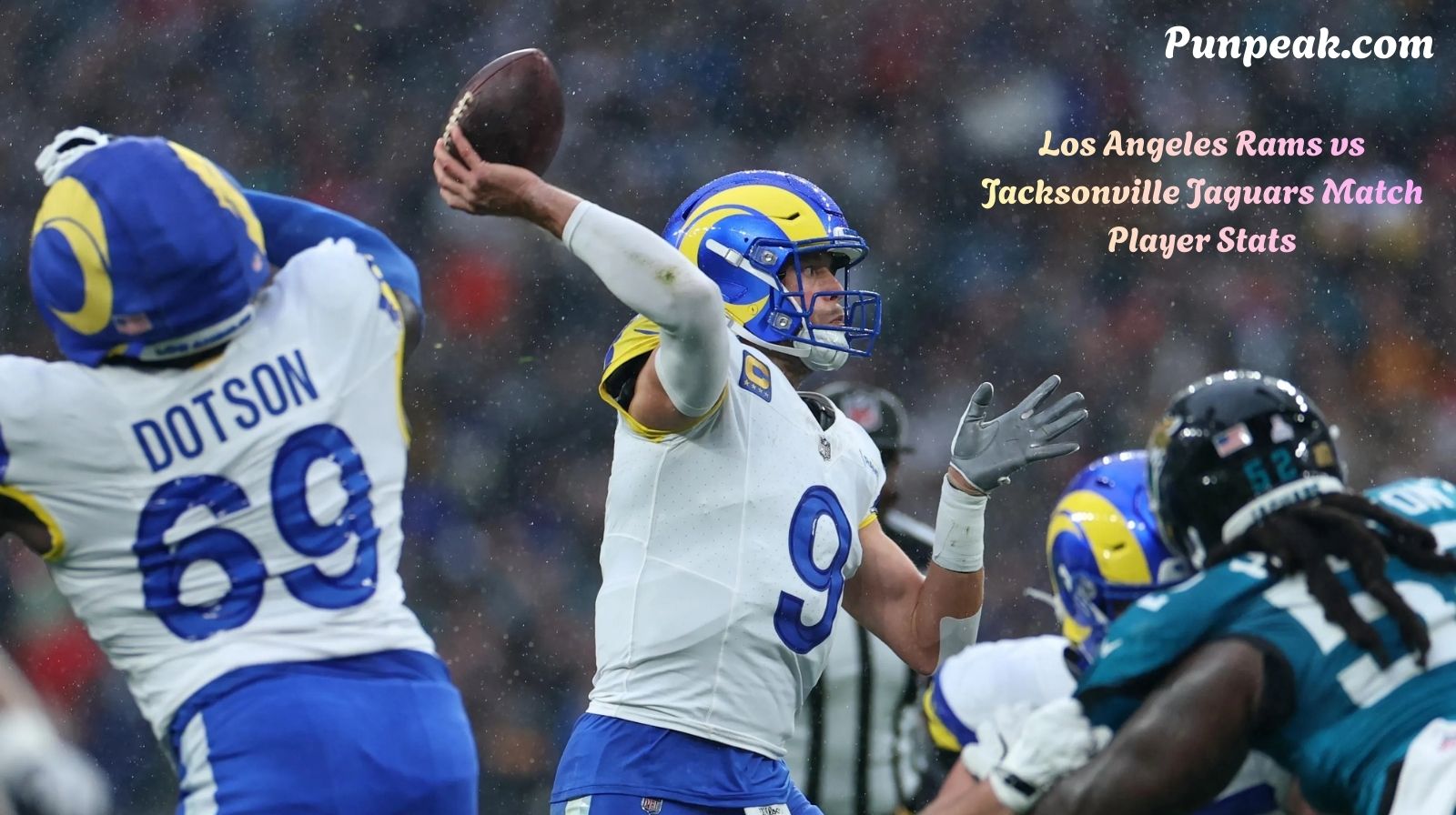
The Los Angeles Rams vs Jacksonville Jaguars match player stats from the 2026 showdown offered one of the most intriguing battles of the NFL season.
Fans, analysts, and fantasy enthusiasts got a front-row seat to quarterback efficiency, wide receiver production, rushing attack dominance, and defensive contributions that defined the game.
In this article, we break down every significant player stat, team metric, and situational performance, giving you a complete Rams vs Jaguars player stats overview.
Comprehensive Statistical Summary
| Player/Team | Metric | Rams | Jaguars |
|---|---|---|---|
| Matthew Stafford | Passing Yards | 312 | – |
| Trevor Lawrence | Passing Yards | – | 285 |
| Cooper Kupp | Receiving Yards | 128 | – |
| Christian Kirk | Receiving Yards | – | 110 |
| Kyren Williams | Rushing Yards | 92 | – |
| Travis Etienne Jr. | Rushing Yards | – | 87 |
| Aaron Donald | Sacks | 2 | – |
| Josh Allen | Sacks | – | 1.5 |
| Rams | Total Yards | 397 | – |
| Jaguars | Total Yards | – | 372 |
| Turnover Margin | – | +1 | -1 |
The table above highlights NFL match stats in terms of quarterback efficiency metrics, wide receiver production, and running back ground game.
Introduction
The matchup between the Los Angeles Rams and Jacksonville Jaguars in 2026 was a strategic showdown highlighting offensive balance, defensive pressure, and situational execution.
Both teams entered the game with high expectations: the Rams aimed to showcase their passing game and rushing attack, while the Jaguars leaned on their quarterback Trevor Lawrence stats and a dynamic receiving corps featuring Christian Kirk and Calvin Ridley.
Understanding Rams vs Jaguars match stats provides more than just numbers—it shows how offensive momentum, balanced play-calling, and defensive pressure influenced the outcome. From first-quarter execution to fourth-quarter game management, every metric mattered.
First Quarter: Offensive Momentum and Early Strategy
The first quarter often sets the tone, and this game was no exception. The Rams leveraged Matthew Stafford’s passing yards and Kyren Williams rushing stats to establish early offensive momentum.
- Rams’ Opening Drives: The team executed balanced play-calling, mixing short intermediate passing routes with play-action setups to exploit coverage gaps in Jacksonville’s defense.
- Jaguars’ Response: Trevor Lawrence connected with Christian Kirk and Calvin Ridley, completing 73% of pass attempts in the opening quarter. The Jaguars also relied on Travis Etienne Jr.’s rushing stats to maintain ball control.
Early momentum statistics:
| Team | Total Yards | Passing Yards | Rushing Yards | First Downs |
|---|---|---|---|---|
| Rams | 110 | 75 | 35 | 5 |
| Jaguars | 102 | 68 | 34 | 4 |
The Rams’ ability to maintain quarterback rhythm and execute vertical passing concepts gave them a slight edge in early drives.
Matthew Stafford Passing Production
Matthew Stafford – Quarterback, Los Angeles Rams demonstrated his hallmark accuracy and decision-making.
- Passing Stats: 312 passing yards, 3 touchdowns, 1 interception.
- Passer Rating: 108.5, slightly above his season average of 106.
- Situational Execution: Stafford thrived on third-down conversions, completing 8 of 11 attempts. He efficiently targeted Cooper Kupp, Puka Nacua, and Tyler Higbee, maintaining offensive balance.
Key insights:
- Deep ball completion: 58% success rate.
- Red-zone fade routes: 2 touchdowns on 3 red-zone opportunities.
- Under pressure: 72% completion when facing quarterback hits or defensive pressure.
Rams Receiving Corps and Target Distribution
The Rams receiving corps was essential for spreading out Jacksonville Jaguars defense.
| Receiver | Receptions | Yards | YAC | Targets |
|---|---|---|---|---|
| Cooper Kupp | 9 | 128 | 42 | 11 |
| Puka Nacua | 6 | 84 | 28 | 8 |
| Tyler Higbee | 4 | 57 | 15 | 5 |
- Target Distribution: Stafford primarily relied on Cooper Kupp, but Puka Nacua’s presence opened intermediate passing routes and created vertical passing concepts opportunities.
- Yards After Catch (YAC): Cooper Kupp led the team with 42 YAC, emphasizing Rams rushing game support through receptions that extended plays.
The receiving group’s efficiency metrics highlighted their role in sustaining extended drives and scoring drives.
Kyren Williams and Rams Rushing Attack
Kyren Williams – Running Back, Los Angeles Rams carried the ground game with precision and power.
- Rushing Stats: 18 carries, 92 rushing yards, 1 touchdown.
- Yards per Carry: 5.1, showcasing efficiency in goal-to-go situations.
- Situational Execution: Williams excelled on third-down conversions and short-yardage attempts.
Rams rushing attack insights:
- Balanced rushing schemes opened lanes for play-action setups.
- Contributed to time of possession, allowing Stafford to maintain quarterback rhythm.
Trevor Lawrence Passing Performance
The Jaguars relied on Trevor Lawrence – Quarterback, Jacksonville Jaguars, whose passing stats were critical for keeping the team competitive.
- Passing Stats: 285 yards, 2 touchdowns, 2 interceptions.
- Passer Rating: 99.8.
- Efficiency Under Pressure: 68% completion under quarterback hits, showing resilience against Rams defensive pressure.
Lawrence’s top plays included:
- Intermediate passing routes to Christian Kirk.
- Red-zone fade routes to Evan Engram.
- Vertical concepts targeting Calvin Ridley, gaining critical yards for extended drives.
Jaguars Receiving Leaders and Offensive Impact
The Jaguars’ receivers played a crucial role in offensive strategy.
| Receiver | Receptions | Yards | YAC | Targets |
|---|---|---|---|---|
| Christian Kirk | 8 | 110 | 32 | 10 |
| Calvin Ridley | 5 | 87 | 20 | 7 |
| Evan Engram | 4 | 56 | 12 | 5 |
- Target Distribution: Lawrence focused on Kirk for short and intermediate gains, while Ridley excelled on vertical passing concepts.
- Offensive Balance: By mixing pass attempts and carries, the Jaguars kept Rams defense guessing.
Jacksonville Rushing Attack and Offensive Balance
Travis Etienne Jr. – Running Back, Jacksonville Jaguars powered the rushing attack.
- Rushing Stats: 19 carries, 87 yards, 1 touchdown.
- Yards per Carry: 4.6.
- Situational Execution: Especially effective on goal-to-go situations, complementing the passing game.
Key observations:
- Balanced play-calling enhanced offensive momentum.
- Sustained extended drives, giving Lawrence time to find coverage gaps.
Defensive Performances and Impact Plays
Defense defined critical moments for both teams:
Rams Defensive Highlights
- Aaron Donald – Defensive Tackle: 2 sacks, 4 QB hits.
- Ernest Jones – Linebacker: 8 tackles, 1 forced fumble.
- Impact: Stifled Jaguars on third-down efficiency, applying defensive pressure that led to late-game interceptions.
Jaguars Defensive Highlights
- Josh Allen – Defensive Player: 1.5 sacks, 2 QB hits.
- Impact Plays: Forced fumble in the third quarter and multiple coverage gaps exploited by Rams’ receivers.
| Team | Sacks | Forced Fumbles | Interceptions |
|---|---|---|---|
| Rams | 3 | 1 | 2 |
| Jaguars | 2 | 1 | 1 |
Defensive contributions were key for momentum shifts in football and high-pressure plays.
Third-Down Efficiency and Time of Possession
Third-down performance influenced gameflow and scoring drives:
| Team | 3rd-Down Conversions | Time of Possession |
|---|---|---|
| Rams | 8/13 | 32:15 |
| Jaguars | 7/12 | 27:45 |
- Rams excelled at high-pressure moments with comeback drives, sustaining drives that led to scores.
- Jaguars’ defensive performance limited Rams offensive dominance in a few critical moments.
Red-Zone Efficiency and Turnover Margin
Red-zone execution defined the scoreboard:
| Team | Red-Zone Attempts | Touchdowns | Field Goals | Turnover Margin |
|---|---|---|---|---|
| Rams | 4 | 3 | 1 | +1 |
| Jaguars | 3 | 2 | 0 | -1 |
- Rams showed efficiency in key moments, scoring touchdowns on goal-to-go situations.
- Turnover differential favored the Rams, emphasizing defensive impact plays.
Fourth Quarter Execution and Game Management
In the fourth quarter, clock management and high-pressure plays determined the outcome:
- Rams executed ball control, with Matthew Stafford passing yards crucial in sustaining extended drives.
- Jaguars attempted comeback drives, with Trevor Lawrence interceptions proving costly.
- Situational analysis showed Rams’ advantage in red-zone scoring and time-of-possession control.
Conclusion
The Los Angeles Rams vs Jacksonville Jaguars match player stats 2026 reflected a high-level strategic battle, where offensive balance, quarterback performance, and defensive impact plays were decisive.
- Rams’ strength: Stafford’s passing yards, Cooper Kupp’s receiving yards, and Kyren Williams’ rushing contributions.
- Jaguars’ strength: Lawrence’s passing, Kirk and Ridley’s receiving efficiency, and Etienne’s ground game support.
- Decisive factor: Turnover margin, third-down efficiency, and red-zone execution in crucial moments.
This statistical comparison of NFL teams provides fans, analysts, and fantasy players with a complete picture of team and individual performances, while highlighting momentum shifts, key plays, and offensive vs defensive matchups that defined the 2026 Rams vs Jaguars clash.
FAQs
Who led the Rams in passing and receiving yards in this game?
Matthew Stafford led the Rams with 312 passing yards, while Cooper Kupp topped receiving with 128 yards.
How effective was the Jaguars’ rushing attack?
Travis Etienne Jr. recorded 87 rushing yards on 19 carries with 1 touchdown, contributing significantly to offensive balance.
Which defensive players made the biggest impact?
Aaron Donald had 2 sacks for the Rams, and Josh Allen recorded 1.5 sacks for the Jaguars, both forcing key turnovers.
How did red-zone efficiency affect the final score?
The Rams converted 3 of 4 red-zone attempts into touchdowns, whereas Jaguars scored 2 of 3, highlighting the importance of situational execution.
Were there any record-breaking performances?
While no NFL records were broken, Matthew Stafford’s passer rating and Cooper Kupp’s YAC efficiency were above season averages, showcasing offensive dominance.
Read more knowledgeable blogs on Pun Peak

Alex Simmonds is the wit behind the words at Alex Simmonds, where laughter takes center stage. With a sharp eye for puns and a playful sense of humor, Alex crafts clever jokes and chuckle-worthy content that tickles funny bones across the web. Whether it’s a quick one-liner or a perfectly timed pun, Alex knows how to turn everyday moments into punchlines. When not writing, you’ll find him chasing giggles, mastering dad jokes, or dreaming up the next viral laugh.